Introduction to an Enduring Legend
Few figures in history command as much fascination and scholarly debate as Alexander the Great. In just 32 short years, this Macedonian king forged an empire that stretched from Greece to India, forever altering the geopolitical landscape of the ancient world. His strategic genius, unyielding ambition, and complex character have cemented his place as one of the most influential individuals to have ever lived. Beyond his military conquests, Alexander's reign sparked a profound cultural transformation, known as the Hellenistic Age, which saw the widespread diffusion of Greek language, art, and philosophy across vast new territories.
This article delves into the epic journey of Alexander, exploring the foundational elements of his empire, the remarkable cartographical challenges of his expeditions, and the multifaceted legacy he left behind. We will uncover how his vision and audacity carved out an unprecedented domain and continue to echo through millennia, inspiring leaders, strategists, and thinkers to this day.
The Rise of a Conqueror: From Macedon to Master of the World
Born in Pella, the ancient capital of Macedon, in 356 BCE, Alexander was destined for greatness. The son of King Philip II, a brilliant military innovator in his own right, Alexander received an education befitting a future monarch, including tutelage from the renowned philosopher Aristotle. This unique blend of practical military training and intellectual refinement shaped Alexander into a leader capable of both inspiring loyalty on the battlefield and appreciating the diverse cultures he encountered.
Upon his father's assassination in 336 BCE, Alexander, then merely 20 years old, swiftly secured his succession. He inherited a powerful, well-trained army and a father's ambition to unify Greece and confront the mighty Persian Empire. What followed was a breathtaking series of campaigns that would define an era:
- The Battle of Granicus (334 BCE): Alexander's first major victory against the Persians, showcasing his cavalry prowess and personal bravery.
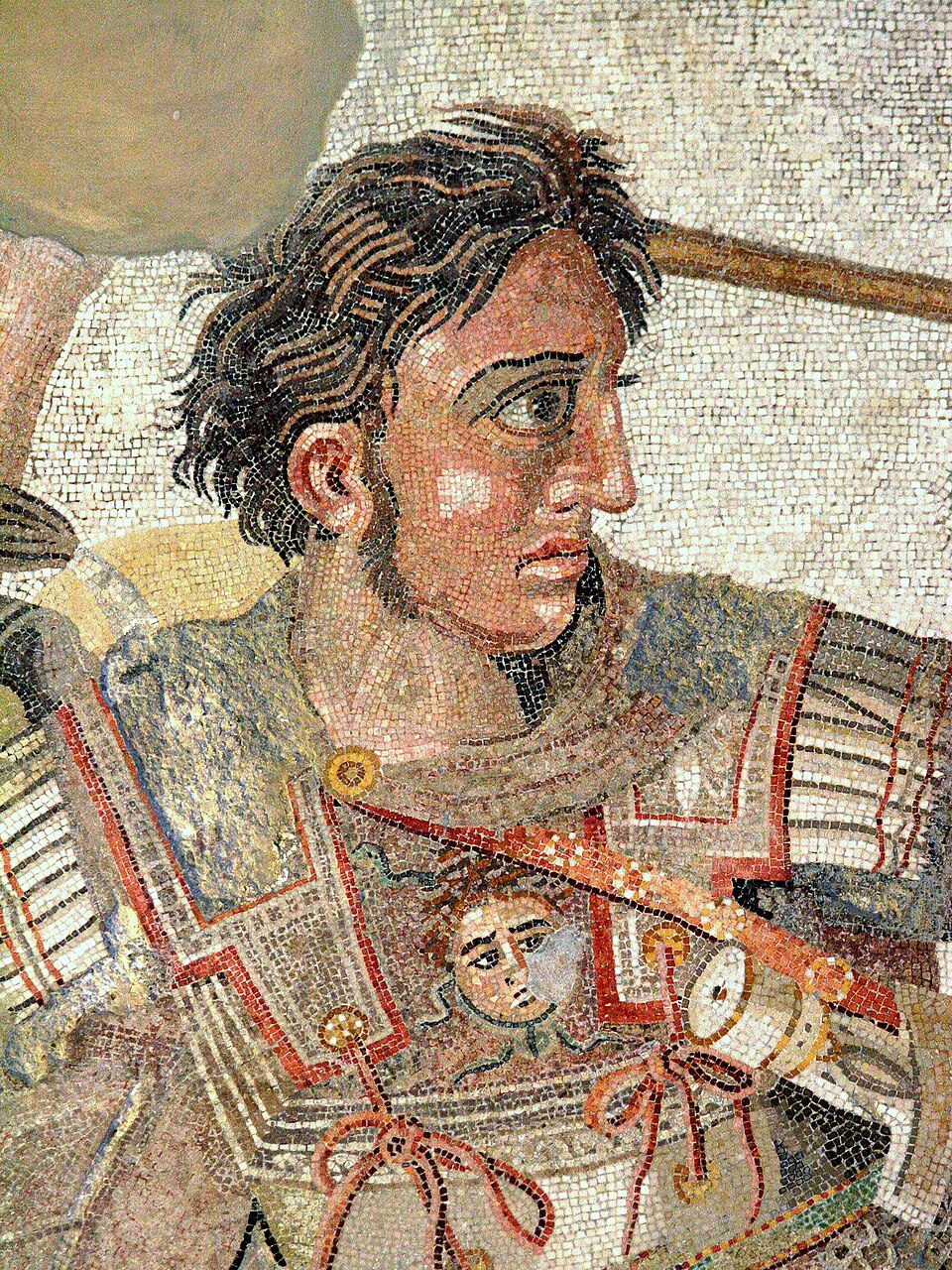
- The Battle of Issus (333 BCE): A decisive triumph over King Darius III himself, securing control of Anatolia. The famous mosaic depicting Alexander in battle captures the intensity of this pivotal moment.
- Conquest of Egypt (332 BCE): Alexander marched into Egypt, where he was welcomed as a liberator and declared pharaoh. Here, he founded the city of Alexandria, a beacon of learning and commerce that would thrive for centuries.
- The Battle of Gaugamela (331 BCE): The ultimate confrontation with Darius III, a monumental clash that shattered the Persian Empire and opened the path to its eastern capitals.
- Advance into India (327 BCE): Driven by a desire to reach the "ends of the world," Alexander pushed his army into the Indian subcontinent, facing fierce resistance, notably at the Battle of the Hydaspes against King Porus.
Through these relentless campaigns, Alexander demonstrated a mastery of strategy, logistics, and psychological warfare. His ability to adapt to diverse terrains and enemy tactics, combined with the unwavering loyalty of his seasoned troops, allowed him to overcome seemingly insurmountable odds.
Charting the Empire: Alexander's Vast Domain
The sheer geographical scale of Alexander's empire was unprecedented. From his Macedonian homeland, his conquests extended across the Aegean Sea, through Anatolia, Syria, and Egypt, incorporating the entirety of the Persian Empire, and reaching as far east as the Punjab region of India. Imagine the challenge of mapping such a vast and unknown territory in the ancient world! While modern cartography was centuries away, Alexander's campaigns nonetheless contributed immensely to geographical knowledge. His expeditions provided valuable data, recorded by his geographers and historians, which expanded the Greco-Roman understanding of the world.
The empire he carved out created a continuous land bridge for cultural exchange. Alexander's vision was not merely conquest but also integration. He established numerous cities, many named Alexandria, strategically placed to serve as administrative centers, military garrisons, and conduits for trade and culture. These cities became melting pots, where Greek colonists mingled with local populations, leading to the flourishing of Hellenistic culture—a dynamic synthesis of Eastern and Western traditions. This phenomenon of Hellenization influenced everything from architecture and art to governance and philosophy, shaping the trajectory of subsequent civilizations.
Understanding Alexander's influence is to appreciate not only the territory he controlled but the cultural seeds he sowed. His empire, though short-lived as a unified political entity, laid the groundwork for the Hellenistic kingdoms of the Diadochi (his successor generals), which continued to propagate Greek influence for centuries after his death. For those keen to understand the deeper implications of his rule, examining
Alexander the Great's Reign: Key Facts and Impact provides further context on the profound changes he initiated.
The Logistical Marvel of Ancient Campaigns
Beyond the battles, the logistical achievement of Alexander's campaigns cannot be overstated. Moving tens of thousands of soldiers, camp followers, engineers, and supplies across deserts, mountains, and rivers for over a decade required meticulous planning and execution. His army built bridges, dug wells, and established supply lines in hostile environments, a testament to ancient military engineering and Alexander's leadership. This logistical prowess allowed his forces to penetrate deeper into Asia than any Western army before them, revealing new trade routes and regions to the Greek world.
The Macedonian Legacy: Enduring Influence and Complexities
Alexander the Great died in Babylon in 323 BCE, possibly from fever, though intrigue and poison have also been suggested. His sudden death, without a clear successor, plunged his vast empire into chaos. His generals, known as the Diadochi, soon carved up his dominion into rival Hellenistic kingdoms—Ptolemaic Egypt, the Seleucid Empire in Asia, and the Antigonid Kingdom in Macedon and Greece. While the political unity dissolved, Alexander's cultural legacy endured and thrived.
Cultural Diffusion and the Hellenistic Age
The Hellenistic Age, sparked by Alexander's conquests, was characterized by an unprecedented blending of Greek and non-Greek cultures. Greek became the *lingua franca* of the educated elite, and Hellenistic cities flourished as centers of learning, science, and art. The Library of Alexandria, founded in the city he created, became the intellectual heart of the ancient world. This cultural synthesis created a vibrant, cosmopolitan environment that would significantly influence the Roman Empire and, eventually, Western civilization.
Military and Leadership Lessons
Alexander's military tactics and leadership style remain subjects of study in military academies worldwide. His innovative use of the Macedonian phalanx, combined with flexible cavalry maneuvers and swift siege warfare, revolutionized ancient combat. Beyond tactics, his personal charisma, willingness to share hardships with his soldiers, and vision inspired unwavering loyalty. Leaders throughout history, from Julius Caesar to Napoleon, have drawn inspiration from his daring and strategic brilliance.
A Complex Historical Figure
Alexander's legacy is not without its complexities. He was a conqueror who brought immense destruction, yet he also fostered cultural exchange and the growth of knowledge. He was hailed as a god by some and a brutal tyrant by others. His ambition bordered on megalomania, leading his weary troops to mutiny in India. Yet, his yearning for exploration and intellectual curiosity led to greater understanding of the world. He was a figure of contradictions, whose actions reshaped the world, leaving behind a testament to human potential and its darker aspects.
Conclusion
Alexander the Great remains an enigmatic and towering figure whose shadow stretches across history. From his audacious conquests that redrew the map of the ancient world to the enduring cultural shifts he set in motion, his impact is undeniable. He forged an empire that, though transient in its political form, ignited a Hellenistic era that fundamentally shaped the course of Western and Middle Eastern civilizations. His legacy is a rich tapestry woven from military genius, cultural diffusion, and the complex interplay of human ambition and vision. Studying Alexander is to understand a critical juncture in human history, a period of dramatic expansion and profound cultural synthesis that continues to resonate today.
While our focus here has been on the historical figure, Alexander the Great, it's worth noting that the name "Alexander" appears in many contexts, including contemporary headlines. For instance, recent news has reported on the
Alexander Brothers Trial: Sex Trafficking Verdict Nears, reminding us that names of great historical significance can be shared by individuals involved in very different stories across time. However, to return to our legend, Alexander the Great’s unparalleled journey continues to captivate, offering timeless lessons on leadership, ambition, and the enduring power of a single individual to alter the course of history.